
A customer has asked to put up a description of their new book. Not to purchase, simply for your thoughts.
Dark story of Gaslighting, abuse, retribution,
and Hope. Based on real conversations with Willow a Hidden Person, and
Richard who removes the so called ‘Pillars-of-society' blocking Willow's pathway to the therapy she will need to escape and recover. He’s aware of the consequences. However, had turned a blind
eye and covered his ears to evil too often. It’s a risk he is going to take. Has no close family or friends for whose safety he’s concerned. His military service and work for the ‘Organisation’
add credibility to his account of the retribution he hands out.
Bella and Richard’s love story sprinkles some sunshine onto this dark tale. Bella is unaware, even when her husband disappears, of the retribution Richard is carrying out to stop Willows abusers.
However, is aware he works for ‘The Organisation,’ but not who they are, or what he is paid to do!
A simple guide to sowing and growing from seeds
follow these five steps to grow from seed
- Simple tools that make sowing seeds easy.
- Sieve and prepare the compost or soil for sowing
- Easiest way to sow seeds.
- Germination of your seeds.
- Tips for easily transplanting seedlings.
- Watering and caring for transplanted seedlings.
Really easy ways to sow seeds, help them germinate and then transplant the seedlings
"How-to" tips to easily sow seeds, see them germinate into seedlings and grow into healthy plants.
Sowing seeds to grow your own fruit, vegetables or flowers to decorate your home is a lot cheaper than buying plants. Probably a lot healthier too. You know where the plants have come from.
The easy way to sow seeds.
Tools you will need to sow seeds.
Seed trays or flowerpots.
You will need a sieve to break down the compost until it is as fine as you can get it.
A small block of wood, or a tamper to firm the compost, I use the back of my hand to firm the surface.
A fine sprayer to keep the seeds and seedlings moist.
An old table or any raised surface so you're not bending, especially if you have a bad back.
Compost for sowing the seeds in.
If you have a compost heap, make your own seed compost, it may need a little more sieving, but it is better and cheaper. Fill your trays or pots to just below the rim, and level the surface making sure not to compact it
Sowing directly into the garden.
Providing the weather conditions allow, springtime is ideal once the frosts are over. Sowing directly into the garden in the spot you want them to grow into plants is my favoured option. Saves all the hassle of transplanting them later, might need a bit of thinning out as the seedlings grow into plants. The seedlings will also need a bit of extra protection from slugs and snails as they germinate and grow into plants.
Prepare the surface of the garden soil by raking over until it is as fine as you can get it.
Providing the weather conditions allow, springtime is ideal once the frosts are over. Sowing directly into the garden in the spot you want them to grow into plants is my favoured option. Saves all the hassle of transplanting them later, might need a bit of thinning out as the seedlings grow into plants. The seedlings will also need a bit of extra protection from slugs and snails as they germinate and grow into plants. Prepare the surface of the garden soil by raking over until it is as fine as you can get it.
How to sow the seeds.
The label on the packet is your best guide to sowing seeds, (especially the depth below the surface). Some seeds will need to be placed in a warm place to germinate, some will not. If you are using seeds saved by friends or neighbours ask them.
The seed packet is your best bet for sowing depth and spacing, but as a general rule, seeds can be sown as below.
50 small seeds or 10 medium seeds or 3 large seeds in a 75mm (3 inch) pot.
100 small seeds or 30 medium seeds in a half size seed tray.
200 small seeds or 50 medium seeds in a full-size seed tray.
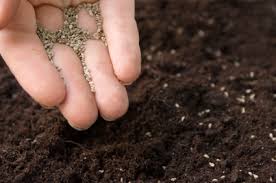
larger types of seeds, like Broad beans are easy to spread evenly, but tiny fine seeds are not so easy. The best way to sow small fine seeds. Is to tip a few into the palm of your hand, take a pinch and sprinkle the seeds evenly over the surface of the compost.
Next sprinkle sieved compost over the seed trays or pots to just cover the seeds. Label them with the plant name and date of sowing. That's it you've sown your seeds.
Seeds can be sown in seeds trays, pots, plug pots or directly into the ground, read the label.
Plant Labels take the guesswork out of identifying the seedlings, if you have sown all of the seeds and left with an empty packet. Put the seed packet on a stick at the end of the row to identify what's growing .
Try Keeping a constant temperature.
If you are not using a propagator or a heated greenhouse covering the tray with glass or even cling film works in the same way.
Watering newly sown seeds.
Stand the seed containers in about 1/2 of water until you see the water rising through the seed compost making the surface moist. Be careful not to saturate, as this could cause the seeds to rot.
Keep the compost moist with a fine spray. You will need to keep an eye on the compost. Making sure it does not dry out, especially if the seeds are being grown in a greenhouse, under glass or in full sun.
Germination and transplanting seedlings
Germination of your seeds.
Cover your seed trays or pots with glass or clear plastic or in a covered propagator and place in a light area that isn't in direct sunlight. The time taken for your seeds to germinate will vary and also be on the seed packet.
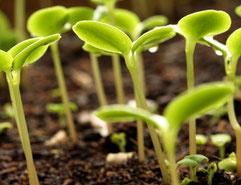
Once the seeds have germinated and the seedlings are large enough to handle. Transplant them giving the seedlings room to spread their roots, grow their stems and replace the seed leaves with maturing leaves.
Transplanting seedlings.
Some seedlings can be transplanted directly into prepared beds in the garden. Others will need to be transplanted into larger containers to harden off or until they are sturdy enough to be planted out. Follow the advice on the seed packet.
Be extra careful when transplanting seedlings not to damage the fragile stems and roots. It is a good idea to dig out the seedlings with a dibber or blunt knife and hold the seedlings by the seed leaves, not the stem. You will damage some seedlings and may find some week and spindly plants caused by overcrowding, there is no point in trying to save them.
Watering and caring for transplanted seedlings
Stand the tray or pots of transplanted seedlings in a container with about a 1/2 inch of water and leave it until you see the surface of the compost just becoming moist, once again being careful not to let the compost become saturated. Plants that have been transplanted directly into the garden will also need watering until the roots become established. It is really important the seedlings are not allowed to dry out, so keep the compost or soil moist.
Keep the transplanted seedlings in a light position and if you are growing in a greenhouse keep the young plants out of direct sunlight. If the seedlings are placed in a shady area they will grow long and spindly looking for and toward light. Week spindly seedlings should be discarded.
The top tip I can give, if you are a beginner at sowing seeds, is to read and follow the advice on the seed packet.
My growing your own page lists a few easy to sow and grow plants.